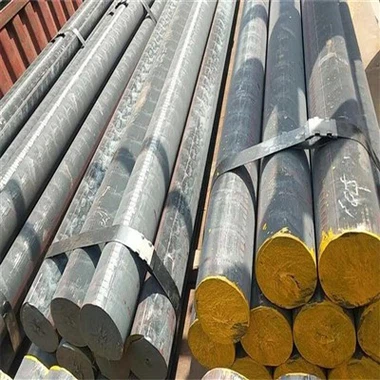
20CrMo5 Acero
El calor tratamiento proceso de 20CrMo5 acero es crucial para optimizar su propiedades mecánicas y asegurar su idoneidad para varias aplicaciones. Recocido es a menudo un paso preliminar. Esto implica calentar el acero a una temperatura específica, usualmente en el rango de 800 grados a 850 grados ,...
Descripción
| Propiedades de 20CrMo5 Acero | Detalles |
|---|---|
| Estándar | [For example, DIN 17200 or other relevant standards depending on the application.] |
| - Cromo (Cr): Aproximadamente 1.0% - 1.3%. - Molibdeno (Mo): Alrededor 0.20% - 0.30%. - Carbono (C): en el rango de 0.17% - 0.24%. - Silicio (Si): Típicamente 0.15% - 0.35%. - Manganeso (Mn): Desde 0.40% - 0.70%. |
|
| Mecánica Propiedades | - Tracción Resistencia: Generalmente entre 880 MPa - 1080 MPa. - Rendimiento Fuerza: Alrededor 685 MPa - 835 MPa. - Elongación: Aproximadamente 12% - 14%. - Impacto Resistencia: Puede tener un impacto energía valor de [especificar valor, e.g., 47 J en habitación temperatura]. |
| Apaga | - Enfriamiento Temperatura: Usualmente en el rango de 850 grado - 880 grado . - Enfriamiento Medio: Comúnmente aceite enfriamiento. |


The heat treatment process of 20CrMo5 steel is crucial for optimizing its mechanical properties and ensuring its suitability for various applications. Annealing is often a preliminary step. This involves heating the steel to a specific temperature, usually in the range of 800 degree to 850 degree , and then slowly cooling it. Annealing helps to relieve internal stresses, refine the grain structure, and improve the steel's machinability. Normalizing is another important process. The steel is heated to a temperature around 880 degree to 920 degree and then air-cooled. Normalizing refines the grain size further, increases the uniformity of the microstructure, and enhances the steel's strength and hardness. Quenching is a key heat treatment step for 20CrMo5 steel. It is typically done by heating the steel to a temperature of about 850 degree to 880 degree and then rapidly cooling it in a suitable quenching medium, such as oil or water. Quenching hardens the steel by transforming its microstructure, increasing its hardness and strength. However, quenched steel can be very brittle. To reduce brittleness and improve toughness, tempering is carried out. The quenched steel is reheated to a lower temperature, usually in the range of 550 degree to 650 degree , and held at that temperature for a specific period. Tempering relieves the internal stresses created by quenching and softens the steel slightly while maintaining a good balance of strength and toughness. The choice of heat treatment parameters depends on the specific requirements of the application. Factors such as the desired mechanical properties, the size and shape of the component, and the manufacturing process need to be considered. Careful control of the heat treatment process is essential to ensure consistent quality and performance of 20CrMo5 steel. In conclusion, the heat treatment of 20CrMo5 steel is a complex and carefully controlled process that plays a vital role in determining its final properties and suitability for different industrial applications.
Etiqueta: 20crmo5 acero, China 20crmo5 acero proveedores, fábrica